
Color
Study it and experiement to find your color story.

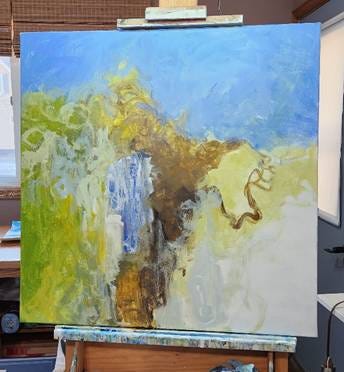
Here’s an example of a work in progress (WIP). The first layer of paint is a mix of titanium white, ultramarine blue, raw umber, and yellow ochre. You can see the range of colors created using only three colors plus white.
I am not an expert on color. Plenty of online resources are available to help you study color – not only the color itself but what color does/accomplishes in a painting. I recently discovered Frank O’Cain (http://www.youtube.com/@frankocain120). I suggest you check out his YouTube channel.
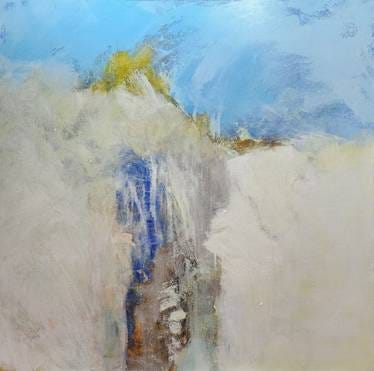
The two pictures above show the process from the early layers to the finished painting. Notice how the greens pull your eye to them. They are lighter than the browns and blacks, yet they are more appealing to the eye.
I could have left this painting alone. It has plenty of energy and an interesting composition. But I am a storyteller and did not find my story in this layer. I kept working. I neutralized most of the color and eventually found the story: Slow Melt. https://www.mefuller.com/shop/p/slow-melt
This online article about Joseph Albers is excellent. I will say that something not mentioned in the excerpt below has to do with the cultural influence brought to bear on how individuals perceive color.
As a graphic designer and art director, I had plenty of opportunities to do press check projects, which meant working with ink press operators to get the right color during printing. That is where I learned that Americans, for example, see the same red formula differently than Japanese consumers.
In contrast, Albers’ teaches you how to truly see color. His central thesis is that there are no absolutes in color. The way humans perceive color is influenced by the surrounding context of neighboring colors, lighting conditions, size and quantity, what we look at before and after, and more. Two colors can look like one. One color can look like two. What looks dull in one context may look bright in another. Reds can look cool-toned, and blues can be warm-toned. As Albers says, “This fact makes color the most relative medium in art.”
The study of color matters for artists and designers. However, for painters, sometimes exploration can open new ways for color to be used successfully. I’m a fan of both study and experimentation. Sometimes, individuals have a vibrant color story inside of them, waiting to be let loose in the world.
What is your favorite color story?